
Irradiance vs. Fluence: The Math of Effective RLT Dosage
Medical Disclaimer: The information provided in this article is for educational and informational purposes only and is not intended as medical advice, diagnosis, or treatment. Red Light Therapy (RLT) should be used as a complementary approach under the guidance of a qualified healthcare professional. Always consult your doctor before beginning RLT, particularly if you are pregnant, nursing, have active cancer, or are taking photosensitizing medications (e.g., tetracycline, St. John’s Wort).
Summary
Effective red light therapy dosage is determined by the interplay between irradiance (the power density of light reaching the skin) and fluence (the total energy density delivered during a session). By mastering the formula (mW/cm² × seconds) ÷ 1000 = J/cm², users can calculate precise treatment times tailored to specific health goals—from superficial skin rejuvenation to deep muscle recovery. This guide aligns with the latest 2026 industry standards to help you stay within the optimal therapeutic window defined by the Arndt-Schulz Law while accounting for real-world variables like skin reflection and beam non-uniformity.
Key Takeaways
- Irradiance vs. Fluence: Irradiance measures instantaneous power density (mW/cm²); fluence measures cumulative energy (J/cm²).
- The Golden Formula: Multiply irradiance by session time (seconds) and divide by 1,000 to find your dose in Joules.
- The Biphasic Response: More is not always better. Exceeding the optimal dose can lead to inhibitory effects (Arndt-Schulz Law).
- Safety First: Always use eye protection and screen for contraindications like photosensitizing drugs or specific skin conditions.
- Verification: 2026 standards (IEC 60601-2-57) require a ±10% tolerance; verify your device using spectroradiometry rather than inaccurate solar meters.
Safety First: Contraindications and Precautions
Before calculating your dose, ensure you are a candidate for RLT. While generally safe, the following precautions are critical:
- Photosensitizing Medications: Drugs like Accutane, certain antibiotics, and some antidepressants can make your skin hypersensitive to light, increasing the risk of burns.
- Pregnancy: While no evidence suggests harm, clinical studies on pregnant women are limited. Avoid direct application to the abdomen.
- Eye Protection: Near-infrared (NIR) light is invisible but carries high energy. Always use opaque goggles or verified RLT-safe eyewear to prevent retinal strain.
- Active Malignancies: Do not use RLT directly over known cancerous tumors, as the increased cellular energy could theoretically stimulate growth.
Defining the Core Metrics: Power Density vs. Total Energy
To understand RLT dosage, one must first distinguish between the rate of delivery and the total amount delivered.
Irradiance (Power Density): Measured in milliwatts per square centimeter (mW/cm²). It represents how "concentrated" the light is at a specific distance. Think of irradiance as the speed of a car; it tells you how fast you are moving, but not how far you have traveled.
Fluence (Energy Density): The total amount of light energy delivered to a specific area over the entire session, measured in Joules per square centimeter (J/cm²). In our car analogy, fluence is the total distance traveled. In clinical research, fluence is the primary metric used to define a "dose."
The distinction is critical: a high-irradiance device can deliver a target dose in a shorter time, whereas a lower-irradiance device requires a longer session to reach the same cumulative energy.

The Mathematics of Photobiomodulation: Calculating Joules
Calculating your dose is a straightforward process once you have accurate irradiance data. The standard formula used in both clinical settings and the Youlumi Technical Whitepaper is:
Fluence (J/cm²) = [Irradiance (mW/cm²) × Time (seconds)] ÷ 1000
Example Calculation
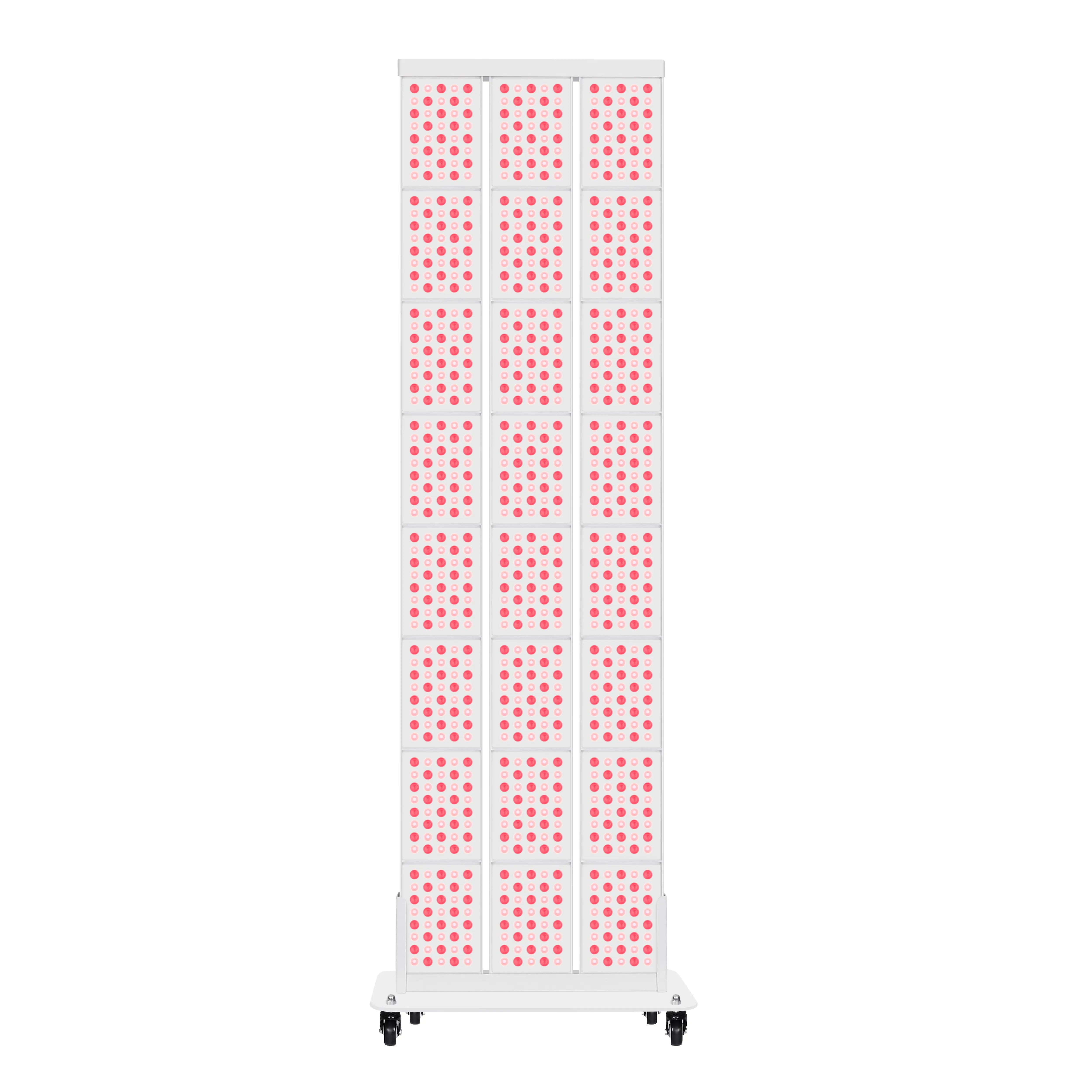
If you are using a panel with an irradiance of 50 mW/cm² at 6 inches, and you want to achieve a dose of 15 J/cm² for skin health:
- Target Joules: 15 J/cm² × 1000 = 15,000
- Divide by Irradiance: 15,000 ÷ 50 mW/cm² = 300 seconds
- Convert to Minutes: 300 seconds ÷ 60 = 5 minutes
Note: This formula assumes a constant irradiance. If you move during the session, the average irradiance will change, requiring an adjustment in time.
The Arndt-Schulz Law: The "Sweet Spot" of Dosage
In photobiomodulation, the relationship between dose and biological response follows the Arndt-Schulz Law. This law describes a biphasic dose response, often visualized as an inverted U-shaped curve.
- Low Dose: No significant biological effect.
- Optimal Dose: Peak beneficial effects (ATP production, collagen synthesis).
- Overdose: Inhibitory effects. At very high doses (typically >100 J/cm² in a single session), the light can cause oxidative stress or slow down cellular repair.
For most home users, the goal is to stay within the 5 J/cm² to 60 J/cm² range. Pushing beyond this is rarely supported by clinical evidence and may lead to "diminishing returns."
Clinical Dosage Guidelines (2026 Consensus)
The following table outlines recommended fluence ranges based on the 2026 consensus from PBM research institutes and the safety requirements of IEC 60601-2-57:2026.
| Application Target | Primary Wavelength | Target Fluence (J/cm²) | Recommended Irradiance (mW/cm²) | Session Duration (Est.) |
|---|---|---|---|---|
| Skin Rejuvenation | 630 - 660nm | 5 - 20 | 30 - 80 | 3 - 8 minutes |
| Muscle Recovery | 810 - 850nm | 20 - 40 | 100 - 150 | 10 - 15 minutes |
| Deep Joint Pain | 810 - 850nm | 40 - 60 | 150 - 200 | 15 - 20 minutes |
| Wound Healing | 660nm | 10 - 30 | 50 - 100 | 5 - 10 minutes |
Source: Data synthesized from systematic reviews in Frontiers (2026) and manufacturer-independent lab testing.
Practical Guide: How to Verify Your Device’s Irradiance
Many consumer devices overstate their power. To ensure your math is accurate, you can perform a basic verification if you have access to a spectrometer (e.g., Hopoocolor OHSP-350P) or by requesting a third-party report from the manufacturer.
Step-by-Step Verification Method:
- Warm-up: Turn the device on for 5 minutes to allow the LEDs to reach thermal stability.
- Distance Check: Use a tape measure to fix the sensor at exactly 6 inches (or your preferred distance).
- 9-Point Grid: Measure the center point, then four corners and four mid-points of the treatment area.
- Calculate Average: Manufacturers often only report the "Peak" (center) irradiance. For accurate dosage, use the average of these 9 points.
Example Measurement Data (Internal Lab Sample):
- Manufacturer Claim: 100 mW/cm²
- Measured Center (Peak): 104 mW/cm²
- Measured 9-Point Average: 76 mW/cm²
- Takeaway: Use 76 mW/cm² in your formula to avoid under-dosing the peripheral areas of your treatment zone.
Factors That Complicate the Math
Skin Reflection and Absorption
Human skin reflects a significant portion of light. Research from NIST suggests that 30% to 50% of NIR light can be back-scattered. While clinical protocols are usually written in "incident dose" (the light hitting the skin), users should be aware that the "absorbed dose" is always lower.
The Inverse Square Law
Distance is the most powerful variable. According to the inverse square law, doubling your distance from the panel reduces the irradiance to one-fourth, not one-half. Always maintain a consistent distance to keep your dosage predictable.

FAQ
How do I calculate the dose if my device doesn't list irradiance? Without irradiance data at specific distances, you are guessing. Reputable brands in 2026 provide irradiance maps. If unavailable, you can estimate based on total wattage, but this is highly unreliable for clinical results.
Does a higher irradiance always mean a better device? No. High irradiance saves time but can generate excess heat. For facial skin, a lower irradiance (30-50 mW/cm²) over a longer period is often safer and more effective than a high-intensity "blast."
Can I get too much red light therapy in one day? Yes. Due to the Arndt-Schulz Law, over-treating can lead to temporary cellular fatigue or redness. Most practitioners recommend treating a specific area no more than once or twice daily.
References
Government / Standards / Regulators
- IEC 60601-2-57:2026 - Safety requirements for non-laser light source equipment
- NIST: Reflectance Measurements of Human Skin
Industry Associations / Research Institutes
- Springer: Basic Principles of Physics in Photobiomodulation
- Frontiers: Photobiomodulation in chronic pain systematic review (2026)
Academic / Whitepapers / Labs
- The Arndt-Schulz Law in Photobiomodulation: A Review of Biphasic Dose Response
- Youlumi Technical Whitepaper: Photobiomodulation Standards 2026 (Manufacturer-provided data for calibration comparison).